

Worrying vs. Thinking: Are You Draining Your Mental Energy?

Photo by kaboompics.com via Pexels
“I’ve been thinking about this for hours — so why can’t I find an answer?"
Sound familiar?
Here’s the truth: you might not be thinking at all. You might just be worrying. These two feel similar, but they are completely different — and understanding the difference can change your daily life.
What the Serenity Prayer Teaches Us
There is a famous prayer, often attributed to theologian Reinhold Niebuhr:
“Grant me the serenity to accept the things I cannot change, the courage to change the things I can, and the wisdom to know the difference."
Reinhold Niebuhr
This simple prayer holds a powerful idea: learn to tell apart what you can change from what you cannot. That is the starting point for shifting from worrying to thinking.
Worrying vs. Thinking — What’s the Difference?
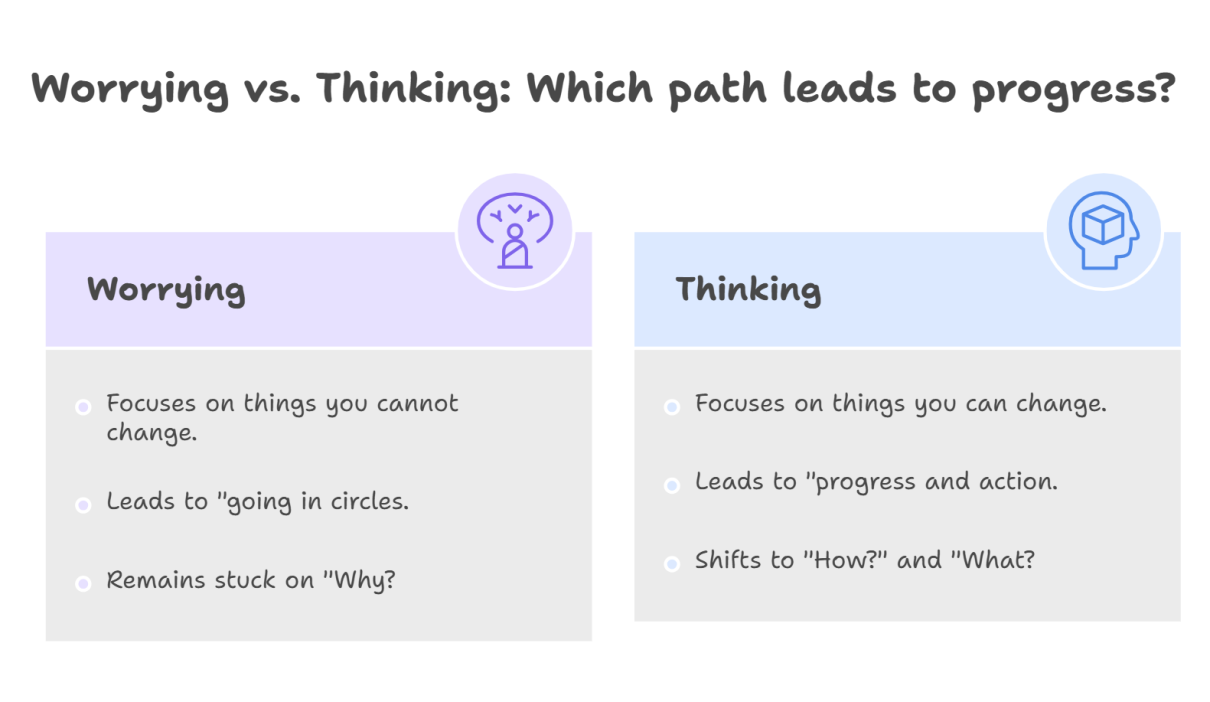
| Worrying | Thinking | |
|---|---|---|
| Focuses on | Things you cannot change | Things you can change |
| Result | Going in circles, exhaustion | Action, progress |
| Energy | Consumed and wasted | Invested in the future |
Worrying means focusing your mind on things beyond your control.
Thinking means focusing on what you can act on — and finding your next step.
What Can You Change? What Can’t You?
🔴 Things you cannot change (worrying about these is pointless)
- Your automatic emotions and body reactions
- Other people’s feelings, actions, or opinions
- The past
- The future (nobody knows what will happen)
- External factors: weather, the economy, society
🔵 Things you can change (worth thinking about)
- Your thoughts right now
- Your actions right now
- How you frame a question or view a situation
- The next small step you can take
Simply put: the only thing you can truly change is your own thinking and actions, right now. Everything else is outside your control, no matter how hard you think about it.
Signs That You’re Worrying, Not Thinking
Watch for these warning signs:
- You keep going over the same thoughts in circles
- You ask “Why does this always happen to me?"
- You replay the past: “If only I had done things differently…"
- You fear the future: “What if things go wrong?"
- The more you think, the heavier you feel
If any of these sound familiar — don’t worry. It doesn’t mean you’re bad at thinking. It just means you’re mixing up worrying with thinking. It happens to everyone. The key is simply to notice it.
The ideaction Method: Switch from Worrying to Thinking

Once you notice you’re worrying, the next step is to switch. The ideaction approach is simple: change the question.
When you’re worrying, your mind is stuck on questions like:
- “Why isn’t this working?"
- “Why does this always happen to me?"
- “Why did that person do that?"
These questions all focus on things you cannot change. No wonder there’s no answer.
Now try reframing them:
| Worrying question ❌ | Thinking question ✅ |
|---|---|
| Why isn’t this working? | What’s one thing I can do right now to improve it? |
| Why does this always happen to me? | What’s a wider way to look at this? |
| Why did that person do that? | What can I do from here? |
| What if I fail? | What’s the smallest thing I can try first? |
Shift from “Why?" to “How?" or “What?" — and your brain will naturally start looking for solutions. This is the problem-solving mindset that ideaction is built on.
Summary: Turn Worrying Time into Thinking Time
- Worrying = staying focused on what you cannot change
- Thinking = focusing on what you can change, and finding action
- The only thing truly in your control: your thoughts and actions, right now
- Change the question from “Why?" to “How?" — and your mind starts moving
The time you spent worrying wasn’t your fault. You just didn’t have the right tool yet.
I hope this article helps you turn your worrying into real thinking.
💡 Want to turn your thoughts into action? ideaction shares practical thinking skills to help you grow. Check out more articles on the site.